Sports Recovery: The Complete Guide to Optimizing Your Performance
Discover science-backed sports recovery methods, sleep, nutrition, active techniques, and how an AI coach can personalize your recovery approach.
Summarize this article with
The essentials in 30 seconds
Recovery is just as important as training itself.
- 1.Sports recovery encompasses all methods that help the body repair after exercise: sleep, nutrition, hydration, and active techniques.
- 2.Without proper recovery, performance stalls, injury risk increases, and fatigue accumulates, overtraining that can take weeks to correct.
- 3.The 3 pillars of good recovery are sleep, post-exercise nutrition, and active methods (stretching, mobility, compression).
- 4.Atlo automatically cross-references your sleep, nutrition, and training data to adjust your recovery recommendations in real time.
Interactive Quiz
What's your recovery profile?
Answer 6 quick questions
How many hours do you sleep on average per night?
📖 What Is Sports Recovery?
Sports recovery refers to all the physiological processes that allow the body to return to its equilibrium state after exertion. During exercise, muscle fibers undergo micro-tears, energy stores (glycogen) are depleted, and the nervous system is taxed. Recovery is when the body repairs this damage and adapts to become stronger, you literally progress during rest.
Without sufficient recovery, the body enters a state of accumulated fatigue that can lead to overtraining: decreased performance, irritability, sleep disturbances, and increased injury risk. A meta-analysis published in the British Journal of Sports Medicine showed that a training program incorporating structured recovery improves performance by 11-18% compared to one without planned recovery.
💪 The 3 Pillars of Sports Recovery
Recovery isn't just one method, it rests on three complementary pillars that work in synergy. Neglecting any one of them compromises the entire recovery process.
| Pillar | Effect on the body | Key methods |
|---|---|---|
| 😴 Sleep | Muscle regeneration, motor memory consolidation, hormonal regulation | 7-9h per night, consistent schedule, cool dark room |
| 🍽️ Nutrition | Glycogen replenishment, muscle repair, rehydration | Protein + carbs within 2h post-exercise, continuous hydration |
| 🏃 Active recovery | Metabolic waste removal, mobility maintenance, reduced soreness | Light walking, gentle stretching, foam rolling, compression |
😴 Sleep: The Best Recovery Tool
Sleep is the most powerful recovery mechanism the body has, no supplement or technique can replace it. During deep sleep, the body releases growth hormone (GH), essential for muscle tissue repair and protein synthesis. Sleep deprivation reduces this secretion by 60-70%, according to a University of Chicago study.
Sleep quality matters as much as quantity. Fragmented sleep, even 8 hours, doesn't produce the same benefits as 7 continuous hours with complete cycles. Elite athletes typically aim for 8-10 hours of sleep per night, with 20-30 minute daytime naps when possible.
🍽️ Post-Exercise Nutrition: What to Eat and When
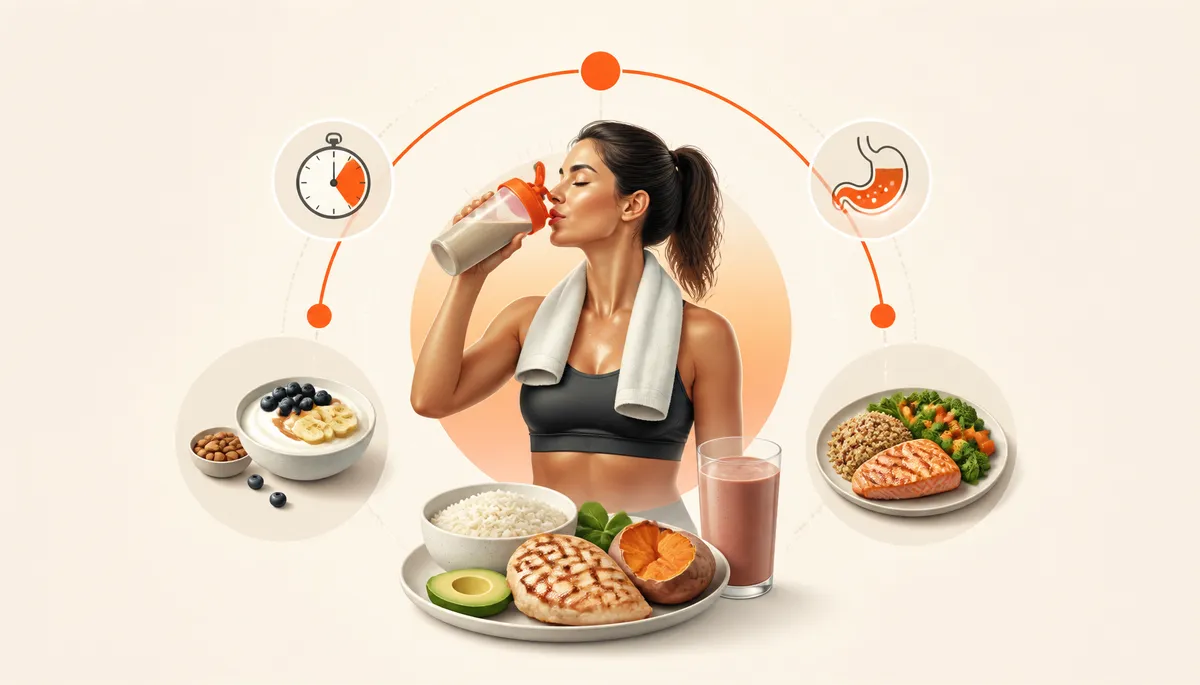
The 2-hour metabolic window after exercise is when the body is most receptive to replenishing reserves. Carbs replenish depleted muscle glycogen, while proteins provide the amino acids needed to repair damaged muscle fibers.
The optimal ratio recommended by the International Society of Sports Nutrition is 3:1 to 4:1 (carbs:protein) for endurance sports, and 2:1 to 3:1 for strength sports. In practice: a complete meal with 20-40g of protein and 60-80g of carbs within 2 hours post-exercise. Hydration is equally crucial: replace 150% of weight lost during exercise (if you lost 1 kg, drink 1.5 L).
🏃 Active Recovery Methods
Active recovery methods use light movement or external stimulation to accelerate the return to equilibrium. Unlike total rest, active recovery promotes blood circulation, which helps eliminate metabolic waste (lactate) and deliver oxygen and nutrients to tired muscles.
Light Active Recovery
Walking, low-intensity cycling, or gentle swimming for 20-30 minutes. The goal is to keep heart rate between 50-60% of max HR, no higher. This approach reduces soreness by 14-30% compared to complete rest, according to a 2022 systematic review.
Stretching and Mobility
Post-exercise static stretching (30-60 seconds per muscle group) helps restore muscle length and reduce tension. Foam rolling (self-massage with a foam roller) decreases perceived soreness by 6-12% and improves short-term range of motion, without negatively impacting performance.
Compression and Massage
Compression garments (socks, sleeves, leggings) apply graduated pressure that promotes venous return and reduces muscle edema. Worn post-exercise for 2-4 hours, they reduce soreness and accelerate strength recovery. Sports massages, meanwhile, decrease inflammatory markers (CRP, IL-6) and pain perception.
🧠 The Role of the Mind in Recovery
Recovery isn't just physical, the mental dimension is equally critical. Psychological stress raises cortisol, a catabolic hormone that hinders muscle repair and disrupts sleep. A stressed athlete recovers less well, even with optimal nutrition and sleep.
Simple techniques like cardiac coherence (6 breaths per minute for 5 minutes), mindfulness meditation (10 minutes per day), or simply disconnecting from screens in the evening significantly reduce physiological stress. A 2023 study on national-level athletes showed that an 8-week meditation program improved sleep quality by 23% and reduced stress markers by 18%.
 How Atlo Optimizes Your Recovery
Atlo is a performance platform that automatically cross-references your sleep, nutrition, and training data to personalize your recovery recommendations. Instead of tracking each pillar separately, Atlo integrates them into a single dashboard, with an AI coach that analyzes the interactions between your metrics.
Personalized Recovery Score
Atlo calculates a recovery score based on deviation from your own baseline, not a generic population threshold. The system integrates heart rate variability (HRV) in logarithmic space, resting heart rate, sleep quality (duration, phases, efficiency), and recent training load to produce a daily recommendation: ready for intense effort, moderate session, or prioritize recovery.
Cross-Referenced AI Coach
Atlo's AI coach uses a multi-agent architecture: specialized agents for nutrition, training, and recovery coordinate their analyses. If your sleep has been degrading for 3 nights while your training load increases, the coach detects it, alerts you, and adjusts recommendations, for example suggesting a lighter session and increased magnesium intake. Every recommendation is explained, never a black box.
Advanced Metabolism and Drift Detection
Atlo estimates your total daily energy expenditure (TDEE) via a Kalman filter, a robust statistical method used in aerospace engineering, rather than simple linear regression. The system also detects adaptive thermogenesis: when your metabolism slows in response to prolonged caloric deficit, Atlo spots it and adjusts your nutritional recommendations to avoid plateaus. This precision allows optimizing recovery nutrition without overcompensating.
📚 Sources and References
These scientific and institutional sources support the recommendations in this guide. All cited data comes from published studies and leading sports science organizations.
- •British Journal of Sports Medicine, Meta-analyse sur la récupération (2022)
- •Pharmacie Lafayette, Guide complet de la récupération sportive
- •Decathlon Conseils Sport, La récupération après le sport
- •International Society of Sports Nutrition, Recommandations nutritionnelles
- •INSERM, Sommeil et récupération : mécanismes physiologiques
🔗 Atlo Resources
Explore our other guides to dive deeper into each pillar of performance:
Sports Nutrition Guide
Everything about exercise-adapted nutrition, from macros to micronutrients.
Strength Training Guide
The principles of weight training, from progression to muscle recovery.
Atlo AI Coach
Discover how our multi-agent AI coach cross-references your data for personalized recommendations.
Whoop vs Oura Ring: Which Wearable to Choose?
Comparison of the two most popular recovery wearables for tracking sleep, HRV, and training.
❓ FAQ
📖 Read next
Ready to optimize your recovery?
Join the Atlo waitlist to be among the first to benefit from an AI coach that automatically cross-references your sleep, nutrition, and training.
lockNo spam. We'll email you at launch.