How Sleep and HRV Impact Your Performance
You know good sleep matters. But do you know exactly how a bad night affects your strength, endurance, and ability to progress? The answer lies in the relationship between your sleep and heart rate variability.
Summarize this article with
Interactive Quiz
Sleep and HRV: what is your profile?
Answer 6 quick questions
How do you rate your sleep?
💤 Sleep: much more than rest
Sleep is often presented as a simple muscle recovery period. That is reductive. While you sleep, your body orchestrates a cascade of biological processes that determine your ability to perform the next day.
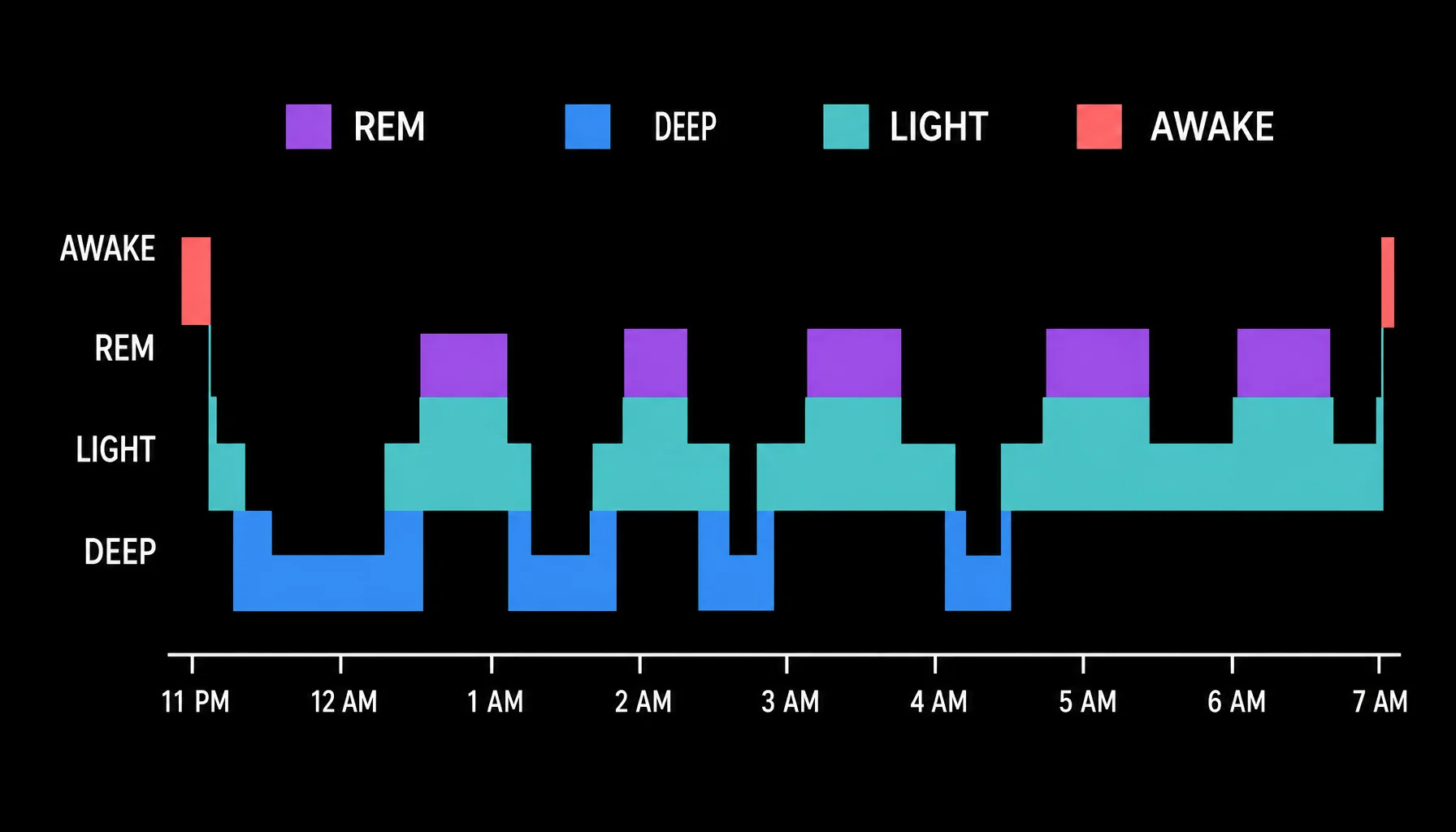
Testosterone and growth hormone, two hormones essential for muscle building and tissue repair, are primarily secreted during deep sleep. A two-hour reduction in deep sleep can decrease growth hormone secretion by 30 to 40 percent. Protein synthesis, the mechanism by which your muscles rebuild after a session, also slows significantly.
But that is not all. Sleep also regulates insulin sensitivity, which determines how your body uses the carbohydrates you consume. A single night of partial deprivation can reduce your insulin sensitivity by 25 percent. In practice, after a bad night, your body stores carbohydrates as fat more easily and uses them less efficiently as fuel.
📊 HRV: the signal everyone ignores (wrongly)
Heart rate variability, or HRV, measures the variation in time between two consecutive heartbeats. Contrary to intuition, a healthy heart does not beat like a metronome. The higher the variability, the more flexible and adaptable your nervous system is.
HRV is a direct indicator of the balance between your sympathetic nervous system (the accelerator, fight or flight mode) and your parasympathetic system (the brake, rest and recovery mode). High HRV indicates parasympathetic dominance: your body is recovering well. Low HRV indicates sympathetic dominance: your body is under stress.
The classic trap: you look at your HRV as an absolute number. Is 45 ms good or not? The answer: it depends on your personal baseline. What matters is not the absolute value but the trend and variation from your average.
🔗 The sleep-HRV relationship: why both must be read together
Here is the central point of this article. Sleep and HRV are not two independent metrics. They talk to each other. Understanding their conversation is what separates an athlete who guesses from one who knows.
Three scenarios that change everything
📏 How to measure and track these two signals
Good news: you do not need a sleep laboratory or a medical-grade electrocardiogram. Modern wearables measure both indicators with enough precision to guide your training.
- 1.Wear your watch or smart ring at night. Every night. Measurement consistency matters more than absolute precision.
- 2.Measure your HRV upon waking, before getting up. Ideally with a dedicated app using the camera or a chest strap. A one-minute measurement is enough.
- 3.Do not react to a single day. A low HRV on a Tuesday morning can be an anomaly. Low HRV three days in a row is a signal. Use a 7-day moving average.
- 4.Correlate with your subjective feeling. If your HRV is low but you feel good, context matters. HRV is a signal, not a dictatorship.
🎯 The Atlo approach: recovery in context
Most sleep apps give you a score. Most HRV apps give you a number. None tells you what these two signals mean together, and certainly not what to do about it relative to your training program.
Atlo cross-references your sleep and HRV with your training load, nutrition, and calorie deficit. Result: a contextualized recommendation, not a raw number. If your HRV is low but your training load was light, the AI coach alerts you to possible external stress. If your sleep is good but your HRV drops after three days of high volume, the coach suggests a deload session.
That is the difference between a dashboard that displays data and a tool that interprets it for you.
Six things you can do tonight to improve your HRV and sleep
These six actions have a measurable impact on sleep quality and HRV, documented by scientific literature.
- •Cut screens 60 minutes before bed. Blue light suppresses melatonin by 50 percent on average.
- •Eat your last meal at least 2 hours before sleep. Active digestion raises heart rate and reduces deep sleep.
- •Keep your bedroom between 16 and 19 degrees Celsius. A cool temperature promotes the drop in body temperature needed to fall asleep.
- •Avoid alcohol on training nights. Even a single drink reduces REM sleep by 20 to 30 percent and drops HRV by 10 to 15 ms the next day.
- •Expose yourself to natural light within the first hour of waking. This anchors your circadian rhythm and improves sleep quality that same night.
- •Practice 5 minutes of slow breathing (4 seconds inhale, 6 seconds exhale) before sleep. Controlled breathing activates the parasympathetic system and raises HRV.
Stop sleeping blind
Atlo reads your sleep and HRV every night, cross-references them with your training and nutrition, and tells you exactly if you are ready. Join the waitlist.
lockNo spam. We'll email you at launch.
❓ Frequently asked questions about sleep and HRV
What is a good HRV value?
There is no good or bad absolute value. HRV depends on age, sex, genetics, and training level. A 25-year-old athlete can have an HRV of 80 ms and a 45-year-old athlete an HRV of 35 ms. Both can be in excellent health. What matters is your personal trend over several weeks.
My HRV fluctuates a lot day to day. Is this normal?
Yes, absolutely. HRV is designed to vary. A perfectly stable HRV would actually be suspicious. What matters is the weekly trend. A fluctuation of 5 to 10 ms around your average is normal. A continuous drop of more than 10 percent over 3 days deserves attention.
Can I train with low HRV?
Yes, but adjust the intensity. Low HRV does not mean you should stay in bed. It means your nervous system is in stress mode. A light to moderate session can even help restore balance. Avoid high-intensity sessions and personal records on those days.
How many hours of deep sleep should I aim for?
Between 1.5 and 2 hours per night for an adult, or about 20 percent of total sleep time. But again, the trend matters more than the absolute value. If your deep sleep drops from 2 hours to 1 hour over several nights without schedule changes, it is a signal your body is accumulating fatigue.
Do naps help HRV?
A 20 to 30 minute nap can indeed temporarily boost HRV by giving your nervous system a reset. However, a nap longer than 45 minutes can disrupt your nighttime sleep and create a counterproductive effect. If you regularly need long naps, it is probably a sign your nighttime sleep is insufficient.
📋 Sleep and recovery metrics compared
Not all recovery metrics are equal. Here are the key signals, what they actually measure, and how to interpret them.
| Metric | What it measures | Optimal range | What to track | Fatigue signal |
|---|---|---|---|---|
| HRV (rmssd) | Autonomic nervous system balance | Individual (trend > 7 days) | 7-day moving average | Drop >10% over 3 days |
| Deep sleep | Physical recovery, growth hormone | 1.5 - 2h (20% of total) | Duration and % of total sleep | < 1h over multiple nights |
| REM sleep | Cognitive recovery, motor learning | 1.5 - 2h (20-25% of total) | % of total sleep | Sharp drop after alcohol/stress |
| Resting HR | Overall cardiovascular load | Individual (typically 40-60 bpm) | Morning average, 7 days | Increase >5 bpm over 3 days |
| Respiratory rate | Physiological stress, post-exercise recovery | 12-16 cycles/min (sleep) | Nightly average | Persistent rise above baseline |
| Total sleep duration | Sleep time consumed vs needed | 7-9h (active adult) | Weekly average + consistency | < 6h cumulative, chronic debt |
📚 Sources and studies
This article draws on scientific literature in sleep physiology and HRV applied to sport.
- •Plews & Laursen et al. (2013) - Training adaptation and heart rate variability in elite endurance athletes. Frontiers in Physiology.
- •Buchheit (2014) - Monitoring training status with HR measures: do all roads lead to Rome? Frontiers in Physiology.
- •WHOOP - How sleep impacts heart rate variability and athletic performance.
- •Sleep Foundation - Physical activity and sleep: how exercise affects your rest.
🔗 Atlo resources
Explore our tools and articles to optimize your recovery and performance.
Published by the Atlo team. Informational article. Atlo is not a medical device.