Why Your TDEE Keeps Changing (And How to Measure It Accurately)
Your metabolism is not a fixed number. It adapts to what you eat, how you train, and how much you move. Understanding this adaptation is the key to never plateauing again.
Summarize this article with
Interactive Quiz
TDEE: do you master your metabolism?
Answer 6 quick questions
Do you know your TDEE?
🔥 What is TDEE exactly?
TDEE stands for Total Daily Energy Expenditure. It's the number of calories your body burns in a day, across all uses.
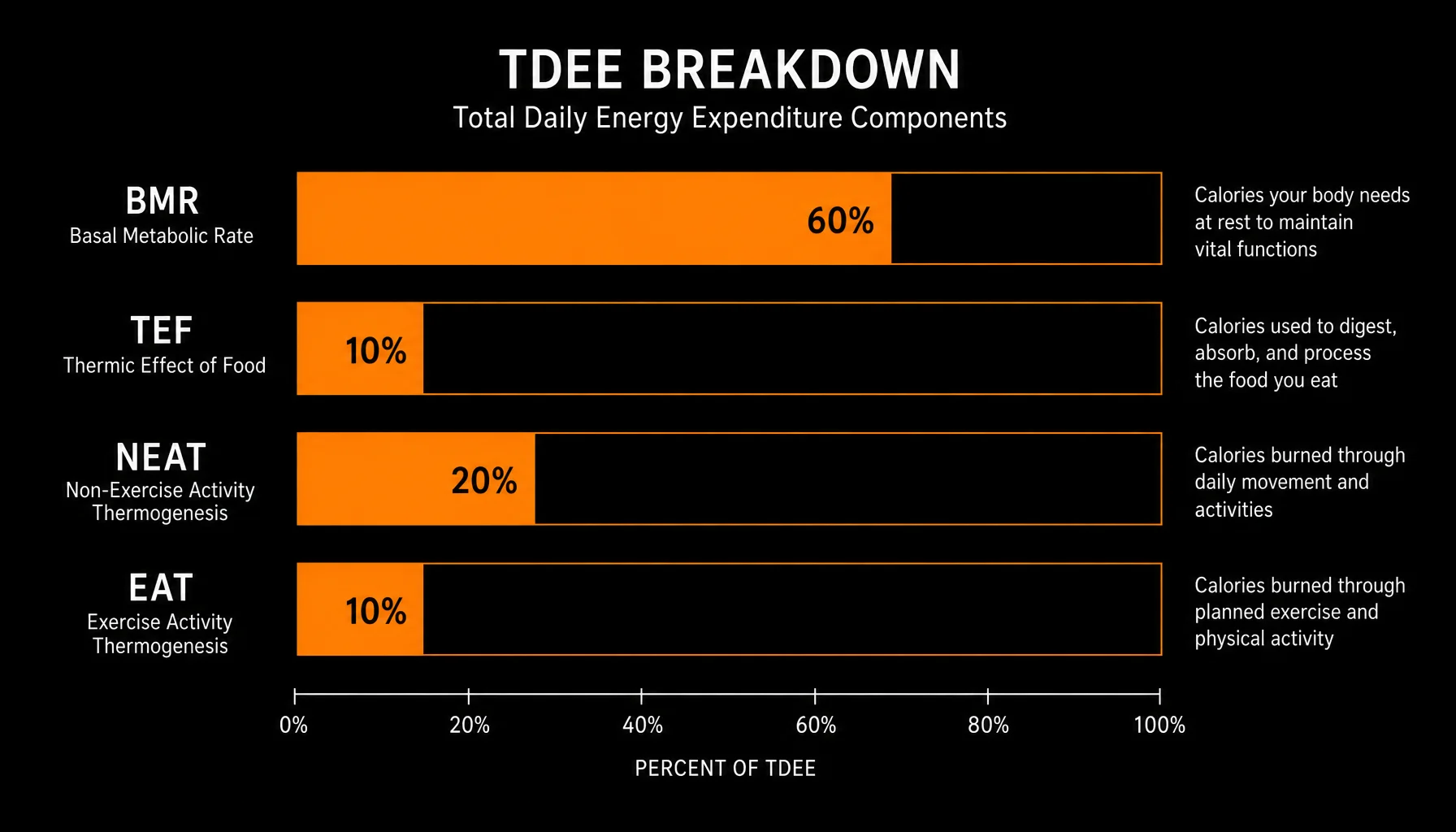
TDEE breaks down into four components: basal metabolic rate (BMR, about 60-70% of total), thermic effect of food (TEF, about 10%), exercise activity thermogenesis (EAT, 15-30%), and non-exercise activity thermogenesis (NEAT, variable). Each component can vary independently, making your TDEE dynamic.
🤔 Why online calculators get it wrong
You have probably used an online TDEE calculator. You enter your age, weight, height, activity level, and it gives you a number. That number is an estimate based on statistical formulas (Harris-Benedict, Mifflin-St Jeor) calibrated on general populations.
The problem: these formulas have a 10-15% margin of error. For someone with a 2,500 kcal TDEE, that's 250-375 kcal of uncertainty. On a targeted 500 kcal deficit, this error can cancel half your deficit or double it without you knowing.
The real question isn't 'what is my TDEE today', but 'how does my TDEE change over time'.
📉 Metabolic adaptation, explained simply
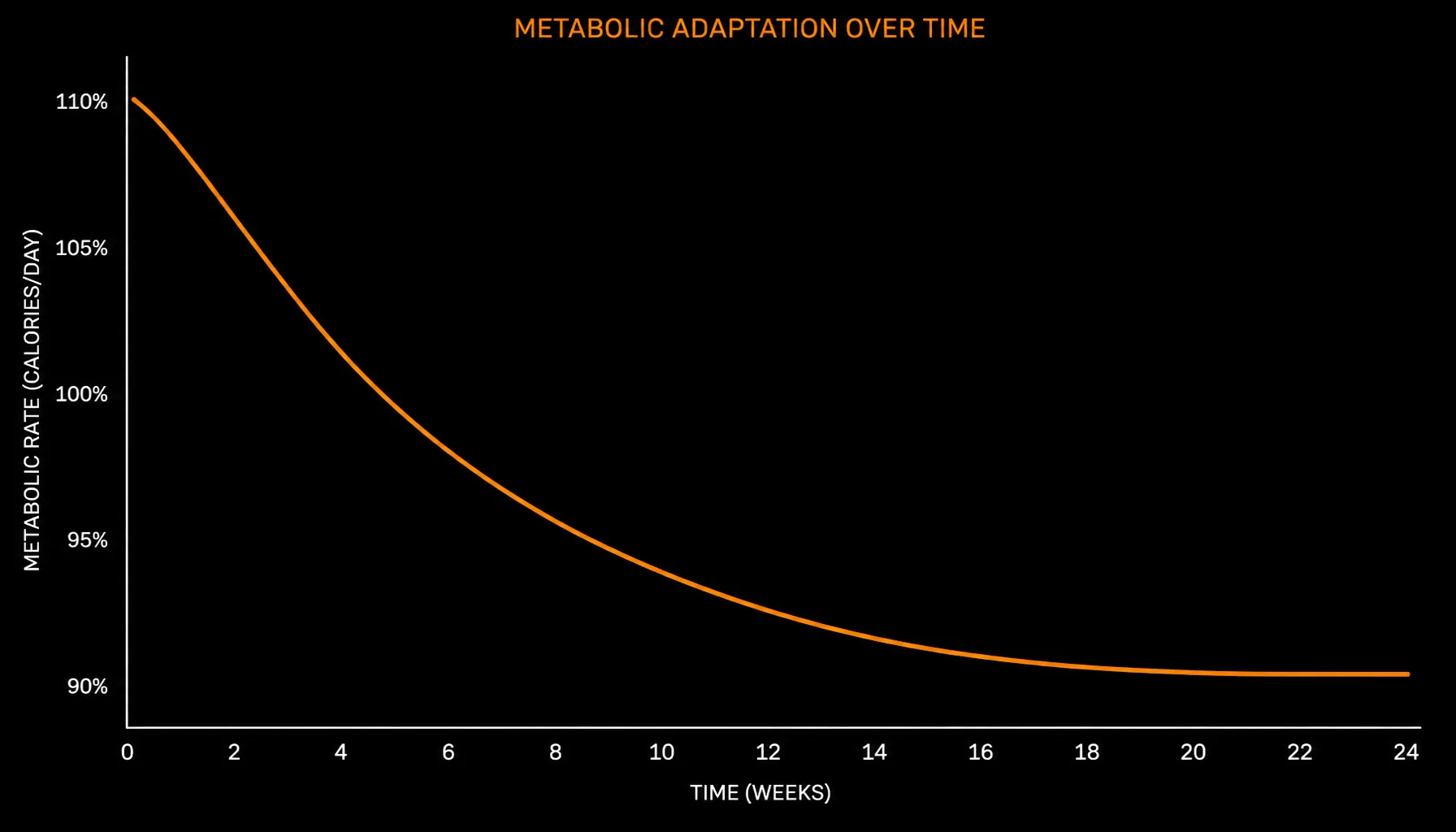
When you create a calorie deficit to lose weight, your body doesn't stay passive. It activates energy conservation mechanisms. This is metabolic adaptation, also called adaptive thermogenesis.
Three things happen. First, your BMR drops because you have less body mass to maintain. Second, your NEAT unconsciously decreases: you move less during the day, fidget less, stand up less often. Third, the energy cost of your workouts drops because you are lighter and more efficient.
Result: a deficit that worked three weeks ago may no longer work today, even if you eat exactly the same thing.
A classic study on The Biggest Loser participants showed their resting metabolic rate remained reduced by 500 kcal per day six years after their massive weight loss. Metabolic adaptation is not a theory, it is a documented physiological reality.
📏 How to measure your real TDEE
The most reliable method doesn't require a lab. It requires consistency. Here is the protocol:
- 1.Weigh yourself every morning, under the same conditions (upon waking, after bathroom, before eating).
- 2.Log everything you eat, to the gram. No estimating, no 'I'll log it tomorrow'.
- 3.After two weeks, look at your weight trend (moving average, not daily weight). If your weight is stable, your average calorie intake = your TDEE. Simple.
- 4.If your weight drops 0.5 kg per week, that's a deficit of about 500 kcal per day. Your TDEE = average intake + 500.
📈 Why your TDEE is not a number, but a curve
Most people treat TDEE as a number to calculate once. In reality, it's a curve that evolves constantly. This curve is influenced by at least eight factors:
- •Your body composition (muscle burns more than fat at rest)
- •Your deficit history (the longer you have been in a deficit, the more your metabolism may have slowed)
- •Your training volume (more volume = more expenditure, but also more fatigue)
- •Your daily steps (NEAT can vary by several hundred kcal per day)
- •Your sleep quality (poor sleep reduces NEAT and can alter hunger hormones)
- •Your stress level (chronic cortisol can promote water retention and alter metabolism)
- •Ambient temperature (your body spends more to maintain temperature in cold weather)
- •Your hormonal cycle (particularly relevant for women, with variations across cycle phases)
🎯 The Atlo approach: real-time adaptive TDEE
Atlo calculates your TDEE differently. Instead of a generic formula applied once, the app recalculates your expenditure daily from your actual data.
Here is how it works: you log your weight every morning and your meals during the day. Atlo also tracks your steps, your workouts, and estimates your NEAT from your activity patterns. Every day, the algorithm compares your calorie intake to your actual weight change and adjusts your TDEE estimate.
After two to three weeks of use, Atlo knows your TDEE with a precision no online calculator can match. And that precision improves over time, because the algorithm learns from your data.
Stop guessing your metabolism
Atlo calculates your real TDEE daily from your data. No generic formula, no 15% margin of error. Join the waitlist.
lockNo spam. We'll email you at launch.
❓ Frequently asked questions about TDEE
What's the difference between TDEE and BMR?
BMR (basal metabolic rate) is the energy your body spends at complete rest to maintain vital functions. TDEE includes BMR plus all other expenditures: digestion, physical activity, daily movements. TDEE represents your actual total expenditure.
Can my TDEE really vary by 500 kcal from one day to another?
Yes, and that's normal. A day with 15,000 steps and a heavy leg session can burn 400-600 kcal more than a sedentary day without training. That's why deficits are managed weekly or monthly, not daily.
Why am I no longer losing weight even though I eat the same?
That's exactly the metabolic adaptation described above. Your TDEE dropped, so your deficit shrank without you changing your intake. The solution is not necessarily eating less: sometimes, a two-week diet break at maintenance restarts the weight loss.
Should I recalculate my TDEE after gaining muscle?
Absolutely. Each additional kilogram of muscle increases your BMR by about 13 kcal per day. Over a 5 kg muscle gain, that's 65 kcal more per day, roughly 2,000 kcal per month. It's significant.
Does a weekend cheat meal throw off TDEE calculation?
If it's exceptional, no. Atlo's adaptive TDEE uses a moving average that smooths out occasional variations. An isolated deviation doesn't skew the trend. However, if you don't log regularly, the estimate loses precision.
⚖️ TDEE calculation methods compared
Not all TDEE calculation methods are equal. Here are the main approaches, from most generic to most precise.
| Method | Required data | Accuracy | Notes |
|---|---|---|---|
| Harris-Benedict | Weight, height, age, sex | Moderate (~10-15%) | Historical formula. Tends to overestimate in obese individuals. |
| Mifflin-St Jeor | Weight, height, age, sex | Good (~8-10%) | Most recommended in clinical practice. More reliable than Harris-Benedict. |
| Katch-McArdle | Weight, % body fat | Good for athletes | Accounts for body composition. Requires reliable body fat % estimate. |
| Cunningham | Lean mass (kg) | Very good for athletes | Derived from Katch-McArdle. Specifically validated on athletic populations. |
| Atlo (adaptive) | Daily weight + calories | Excellent (~3-5%) | Adjusts daily from your real data. No generic formula. |
📚 Sources and studies
The information in this article is based on scientific literature and expert analyses in metabolism.
- •Fothergill et al. (2016) - Persistent metabolic adaptation 6 years after The Biggest Loser competition. Obesity.
- •Mifflin et al. (1990) - A new predictive equation for resting energy expenditure in healthy individuals. AJCN.
- •Trexler et al. (2014) - Metabolic adaptation to weight loss: implications for the athlete. JISSN.
- •The Metabolic Adaptation Manual - in-depth analysis by Stronger By Science.
🔗 Atlo resources
Explore our tools and articles to go further in understanding your metabolism.
Published by the Atlo team. Informational article. Atlo is not a medical device.