An AI sports coach that sees everything , not just your workouts
Summarize this article with
Interactive Quiz
AI Coach: is it for you?
Answer 6 quick questions
What is your goal?
- 1.An AI sports coach is a personalized program, available 24/7, that adapts to your goals and fitness level.
- 2.The problem: almost all solutions only see one dimension , your training. They ignore your sleep, nutrition, and recovery.
- 3.Result: recommendations disconnected from your actual state. You push hard on a day your body needs rest. You stall while your calorie deficit undermines muscle growth.
- 4.Atlo is the only platform that cross-references nutrition, training, and recovery in a unified dashboard, with a multi-agent AI coach that has persistent memory.
 What an AI sports coach can do (and what most miss)
A good sports AI coach does things a human coach can't do at this price. It generates a personalized AI training program in seconds, adjusted to your level, equipment, and goals. Available at 6am or 11pm. Never judges, never tires, never takes vacations. A traditional coach costs €60-120 per session in France , €200-600 per month. An AI coach: from €8.99/month.
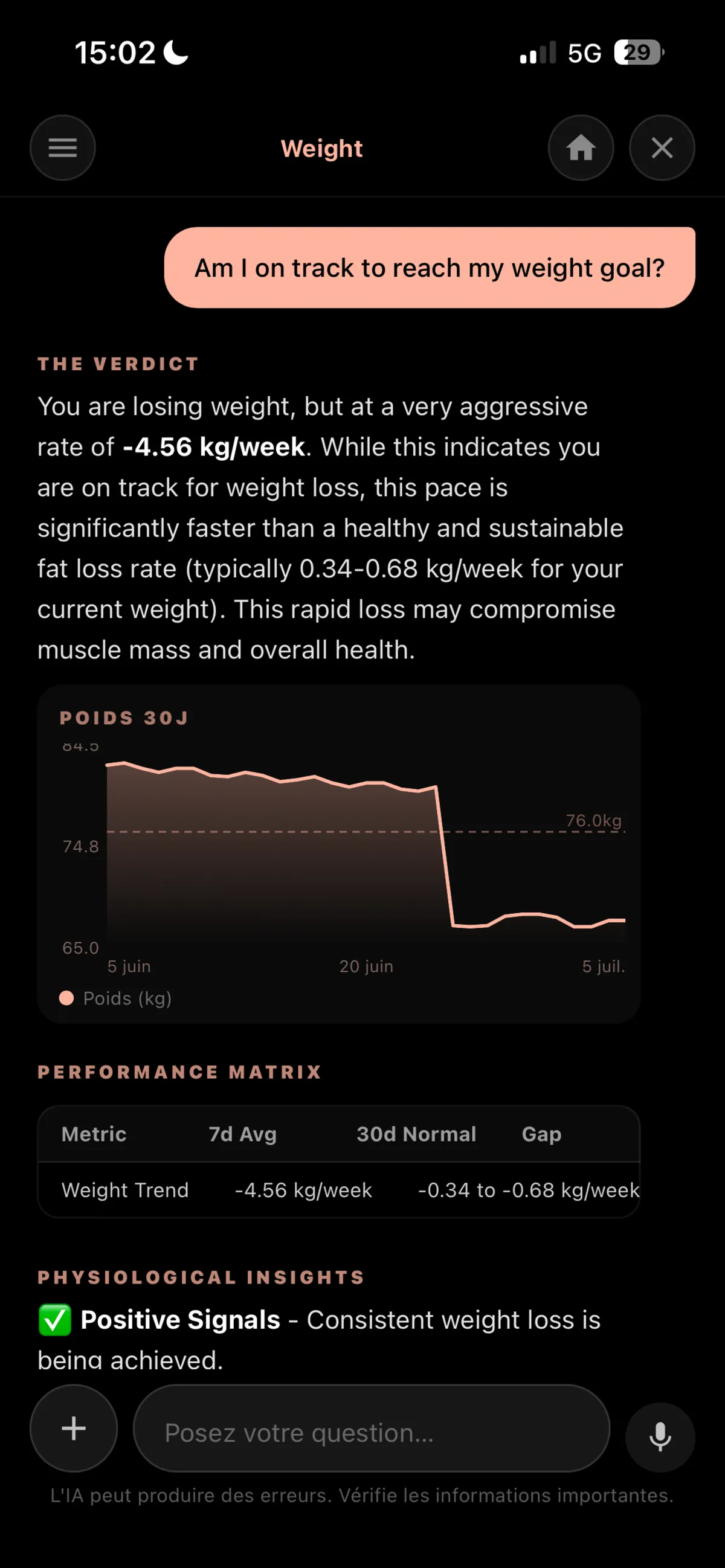
But here's the limit nobody talks about. Most AI coaches only see your workouts. They don't know you slept 5h30 last night. They don't know you've been in a calorie deficit for 10 days. They have no idea your HRV dropped 18% this week. So they prescribe a heavy session. And you obey , because the algorithm said so. It's optimizing in the dark.
🧩 The silo problem: separate nutrition, training, recovery
Picture this. You sleep poorly three nights in a row , 5h average, fragmented sleep. Your morning HRV drops from 68ms to 44ms. Your autonomic nervous system is under strain. According to Plews et al. and Buchheit, an HRV drop greater than 1 standard deviation below your 7-day baseline is an early warning signal of overtraining.
Your classic AI sports coaching doesn't know this. It schedules a heavy squat session at 85% of your 1RM. You go. You get injured, or you stall, or you accumulate fatigue that costs you two weeks of recovery.
Second scenario. You've been in a calorie deficit for 12 days , 400 kcal below your TDEE. Your body lacks protein for muscle synthesis. Your AI coach sees you haven't progressed on bench press in three weeks. It increases volume. It doesn't know the problem isn't the training , it's the plate.
A coach that only sees one dimension gives bad advice. Not because it's bad. Because it's blind. Studies show that AI-assisted programs reduce injury risk by up to 25% , but only when they integrate recovery data. Without it, the advantage disappears.
⚙️ How Atlo's AI coach works
Atlo isn't a program generator. It's a multi-agent architecture. Three specialized agents, one coordinating brain:
- —Nutrition agent: analyzes your intake, macros, calorie deficit or surplus, micronutrients.
- —Training agent: manages your load, progressive overload, periodization.
- —Recovery agent: reads your HRV, sleep score, SpO2, estimated VO2 max.
These three agents communicate in real time. When the recovery agent detects an HRV drop, it signals the training agent, which adjusts the day's intensity. When the nutrition agent detects a cumulative deficit that's too large, it informs the training agent, which adjusts volume.
Persistent memory. The coach remembers everything: your past sessions, uploaded blood tests, weekly check-ins, dietary preferences. No need to re-explain yourself every conversation.
Full explainability. Every recommendation is explained. The coach doesn't just tell you to lower the load. It tells you why: your HRV dropped 18% this week, your recovery score is 34/100, today is an active recovery day, not a performance day.
🔄 What Atlo cross-references in real time
Sleep and training: if your recovery score is low, the coach adjusts intensity. No heavy squats after a 5-hour night.
Nutrition and progression: if your cumulative deficit exceeds the threshold, the coach adjusts macros instead of just increasing training volume.
HRV and training load: overtraining detection before you feel it. The coach reduces load before you get injured.
📊 All your data, one place
Unified dashboard. Nutrition: CIQUAL, USDA, Open Food Facts, 100+ metrics per food, barcode scanning, AI photo. Training: exercise catalog, progressive overload, anatomy heatmap. Recovery: sleep phases, HRV, SpO2, VO2 max. Supplements, intermittent fasting, Apple HealthKit and Android Health Connect sync.
💡 Why explainability changes everything
Atlo's AI coach explains every recommendation. No opaque algorithm. You understand why you should lower intensity today, why increase carbs tomorrow. Trust isn't built on blind faith. It's built on understanding.
⚖️ Comparison: Atlo AI Coach vs human coach vs classic app
| Atlo | Human coach / Classic app | |
|---|---|---|
| 24/7 availability | check_circle | Human coach: no (by appointment) / Classic app: yes |
| Persistent memory and context | check_circle | Human coach: limited (notes) / Classic app: no |
| Cross-references nutrition + training + recovery | check_circle | Human coach: manual and rare / Classic app: no |
| Real-time adaptation to physiological data | check_circle | Human coach: during session / Classic app: basic |
| Monthly cost | 8,99 €/mois | Human coach: 200-600 EUR / Classic app: 0-30 EUR |
| Recommendation explainability | check_circle | Human coach: variable / Classic app: no |
| Real-time form correction | - | Human coach: yes / Classic app: no |
| In-person motivational support | - | Human coach: yes / Classic app: no |
📚 Sources & references
- 1.Plews DJ, Laursen PB et al. - Training adaptation and heart rate variability in elite endurance athletes. Sports Medicine, 2013.
- 2.Buchheit M. - Monitoring training status with HR measures: do all roads lead to Rome? Frontiers in Physiology, 2014.
- 3.Application of Artificial Intelligence for Predicting Sports Injuries and Customizing Personalized Prevention Strategies: A Scoping Review, 2025.
- 4.Jager R, Kerksick CM et al. - International Society of Sports Nutrition Position Stand: protein and exercise. JISSN, 2017.
🔗 Useful resources
Free TDEE Calculator
Estimate your total daily energy expenditure in 30 seconds.
RIR vs RPE Guide
Understand the difference between RIR and RPE to better manage your training load.
Atlo Product Roadmap
Discover upcoming Atlo platform features.
Sports Nutrition App
Discover how Atlo's intelligent nutrition tracking complements your training.
Read next
Try the AI coach that sees everything
Join the waitlist to be among the first to try Atlo's multi-agent AI coach.
lockNo spam. We'll email you at launch.
❓ Frequently asked questions
Can an AI coach replace a human coach?
For programming, data analysis, and real-time adaptation, yes. For in-person form correction and motivational support, no. Atlo is designed as a complement, not a replacement.
What data does Atlo use to personalize recommendations?
Your AI coach reads your nutrition data (meals, macros, micronutrients), training data (loads, volume, progression), recovery data (sleep, HRV, SpO2, VO2 max), your profile (goals, morphology, fitness level), and documents you share (blood tests, existing programs).
How does Atlo's AI coach adapt in real time?
The three agents (nutrition, training, recovery) communicate with each other on every new data point. An HRV drop adjusts the day's intensity. A prolonged calorie deficit adjusts macros and volume. It's all automatic.
Does Atlo work without an Apple Watch or wearable?
Yes. You can manually log your weight, meals, and workouts. Wearables (Apple Watch, Garmin, Whoop) enrich recovery data but are not required.
Is Atlo's AI coach suitable for beginners?
Yes. The coach adapts to your level. If you're a beginner, it offers progressive programs with fundamental exercises and detailed explanations. If you're advanced, it handles periodization, progressive overload, and variations.
Atlo is not a medical device. AI coach recommendations are based on statistical algorithms and do not replace professional medical advice.