HIIT Interval Training: Complete Guide to Get Started and Progress
Discover High Intensity Interval Training (HIIT): benefits, protocols, exercises and a beginner program. Boost your cardio and burn calories in record time.
Summarize this article with
The essentials in 30 seconds
HIIT, or High Intensity Interval Training, is a method that alternates intense efforts with recovery phases. It's one of the most efficient ways to improve fitness in a short time.
- 1.HIIT burns up to 30% more calories than steady-state cardio for the same duration, thanks to the EPOC (afterburn) effect.
- 2.10 to 30 minutes is enough for an effective session : perfect for busy schedules.
- 3.Protocols are varied: Tabata (20s/10s), 30/30, 60/30, 7-minute workout : there's a format for every level.
- 4.No equipment needed: bodyweight HIIT is just as effective as equipment-based versions.
- 5.Atlo integrates HIIT into its personalized programs, with recovery tracking to prevent overtraining.
Interactive Quiz
Which HIIT is right for you?
Answer 6 quick questions to discover your ideal HIIT profile
What's your current fitness level?
📖 What is HIIT Interval Training?
HIIT (High Intensity Interval Training) is a training method that alternates very intense effort phases with active or passive recovery phases. Unlike steady-state cardio where you maintain constant intensity, HIIT plays on heart rate variations to maximize physiological adaptations.
The principle is simple: you go all-out for 10 to 60 seconds, then recover for a proportional duration (often a 2:1 or 1:1 work-to-rest ratio). A typical session lasts 10 to 30 minutes, including warm-up and cool-down.
The term 'interval' comes from the fact that the total effort is broken into intervals, as opposed to continuous effort. This approach, popularized in the 1990s by Japanese researcher Izumi Tabata, is now validated by dozens of scientific studies.
💪 7 Science-Backed Benefits of HIIT
HIIT isn't just a trend: it's one of the most scientifically studied training methods. Here's what research has demonstrated, with measurable effects on health and performance.
1. Burns more calories in less time
A 20-minute HIIT session can burn as many calories as a 40-minute steady-state cardio session. The EPOC effect (Excess Post-Exercise Oxygen Consumption), also called 'afterburn', keeps the metabolism elevated for 12 to 24 hours post-session. A study published in the Journal of Strength and Conditioning Research shows that HIIT increases post-exercise caloric expenditure by 6 to 15% compared to steady-state cardio.
2. Improves VO2 max and cardiovascular capacity
VO2 max, which measures the body's ability to use oxygen, is one of the best predictors of longevity. Studies show that 6 to 8 weeks of HIIT (3 sessions/week) increase VO2 max by 7 to 15%, equivalent to 2 to 3 times more steady-state cardio. A 2019 meta-analysis in Sports Medicine confirms that HIIT is superior to continuous cardio for improving VO2 max in both sedentary adults and athletes.
3. Reduces abdominal and visceral fat
HIIT specifically targets visceral fat, the type surrounding organs that poses the greatest health risks. A 2018 systematic review showed that HIIT reduces total fat mass by 1.3 to 2.5 kg over 8 to 12 weeks, with a particularly marked reduction in abdominal fat. This effect is observed even without an associated diet.
4. Preserves muscle mass unlike steady-state cardio
Unlike steady-state cardio which can lead to muscle loss, HIIT stimulates type II (explosive) muscle fibers and promotes protein synthesis. HIIT exercises often include functional movements (squats, burpees, lunges) that engage large muscle groups. Result: you lose fat without losing muscle, which is crucial for basal metabolism.
5. Improves insulin sensitivity
HIIT improves the body's ability to use glucose, reducing the risk of type 2 diabetes. A 2015 study in Diabetologia showed that 2 weeks of HIIT (3 sessions of 25 min) improved insulin sensitivity by 23% in healthy adults. This effect is particularly important for overweight individuals or those at metabolic risk.
6. Stimulates growth hormone and testosterone
Short, intense efforts trigger a release of anabolic hormones. A HIIT session can increase growth hormone by 400 to 700% for 24 hours and acutely boost testosterone. These hormonal responses promote fat burning, muscle recovery, and anti-aging. This is one of the mechanisms behind the anti-aging benefits of HIIT documented by AFME.
7. Improves mental health and reduces stress
HIIT releases endorphins and endocannabinoids, providing a lasting sense of well-being after the session. Recent studies show that HIIT reduces anxiety and depression symptoms comparably to traditional aerobic activity, but in half the time. The intensity of the effort also creates a mental 'flow' that pushes away intrusive thoughts.
🛠️ The 5 Most Effective HIIT Protocols
Not all HIIT is created equal. The choice of protocol depends on your level, goals, and available time. Here are 5 scientifically validated protocols, ranked from most intense to most accessible.
| Protocol | Effort | Recovery | Duration | Level |
|---|---|---|---|---|
| Tabata | 20 seconds | 10 seconds | 4 minutes (8 cycles) | ★★★★★ |
| Classic 30/30 HIIT | 30 seconds | 30 seconds | 10 to 20 minutes | ★★★★☆ |
| 60/30 (moderate intensity) | 60 seconds | 30 seconds | 15 to 25 minutes | ★★★☆☆ |
| 7-minute workout | 30 seconds | 10 seconds | 7 minutes (12 exercises) | ★★☆☆☆ |
| Beginner 20/40 HIIT | 20 seconds | 40 seconds | 10 to 15 minutes | ★☆☆☆☆ |
🏃 How to Start HIIT: 4-Week Progressive Program
If you've never done HIIT, don't start with Tabata. The risk of injury and dropout is real. Here's a 4-week progressive program that takes you from beginner to intermediate safely.
Week 1: Introduction (20/40, 3 sessions)
20 seconds effort | 40 seconds recovery | 8 cycles | 3 exercises
Three simple bodyweight exercises: jumping jacks, high knees, bodyweight squats. 8 repetitions of 20 seconds effort followed by 40 seconds recovery. Total duration: 13 minutes including warm-up. The goal is to learn the rhythm, not to go into the red.
Week 2: Progression (30/30, 3 sessions)
30 seconds effort | 30 seconds recovery | 10 cycles | 4 exercises
Add one exercise and lengthen the cycles. Four exercises: jumping jacks, jump squats, mountain climbers, alternating lunges. 10 cycles of 30/30. Duration: 16 minutes. Intensity should be 7-8/10 on the perceived exertion scale.
Week 3: Intensification (30/20, 3 sessions)
30 seconds effort | 20 seconds recovery | 12 cycles | 5 exercises
Recovery shortens, effort becomes more demanding. Five exercises: simplified burpees, jumping jacks, jump squats, mountain climbers, dynamic plank. 12 cycles. Duration: 18 minutes. Intensity should reach 8-9/10 on the last repetitions.
Week 4: Consolidation (choose your protocol)
Tabata, 30/30, or 60/30 | 3 to 4 sessions | depending on your goals
You now have the basics to choose the protocol that matches your goals. Weight loss: prefer 60/30 with full-body exercises. Performance: adopt Tabata or 30/30. Maintenance: alternate formats to avoid monotony. Consistency is now key.
🎯 The 12 Best Exercises for a HIIT Session
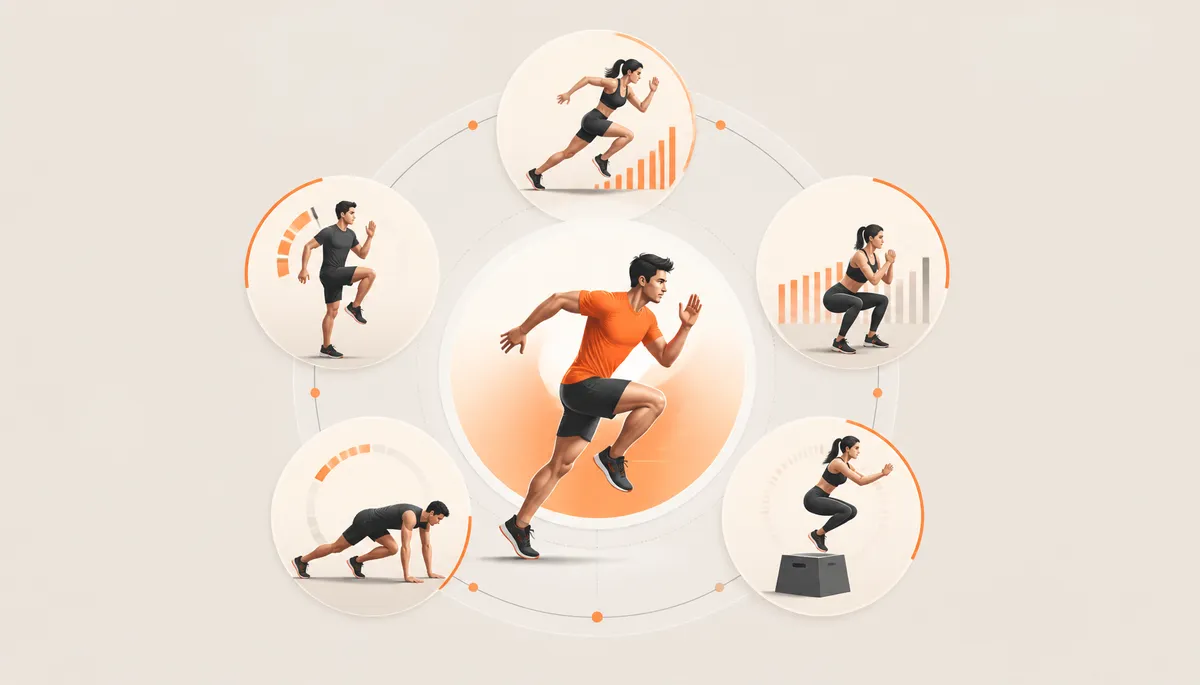
A good HIIT exercise is a movement that engages multiple muscle groups simultaneously and can be performed at high intensity without risk of losing technique. Here are the 12 most effective exercises, ranked by difficulty level.
| Exercise | Targeted muscles | Impact | Level |
|---|---|---|---|
| Jumping jacks | Full body, cardio | Low | ★☆☆☆☆ |
| High knees | Cardio, abs, legs | Low | ★☆☆☆☆ |
| Bodyweight squats | Legs, glutes | Low | ★☆☆☆☆ |
| Alternating lunges | Legs, glutes, balance | Moderate | ★★☆☆☆ |
| Mountain climbers | Abs, cardio, shoulders | Moderate | ★★☆☆☆ |
| Push-ups | Chest, shoulders, triceps | Moderate | ★★☆☆☆ |
| Dynamic plank | Abs, lower back | Moderate | ★★★☆☆ |
| Jump squats | Legs, explosiveness | High | ★★★☆☆ |
| Burpees | Full body, cardio | High | ★★★★☆ |
| Kettlebell swings | Posterior chain, cardio | High | ★★★★☆ |
| Thrusters (dumbbells) | Legs, shoulders, cardio | Very high | ★★★★★ |
| Sprints | Legs, power, cardio | Very high | ★★★★★ |
😴 Recovery and HIIT: The Essential Duo
HIIT is demanding on the nervous and muscular systems. Without adequate recovery, the benefits cancel out and the risk of overtraining increases. Here are the golden rules for stacking sessions without burning out.
Allow 48 hours between two HIIT sessions
HIIT intensely taxes the central nervous system. Studies show that HIIT performance decreases by 8 to 15% if sessions are too close together (less than 24h). The optimal frequency is 2 to 3 sessions per week, with at least one rest day between each.
Monitor your heart rate variability (HRV)
HRV is the best indicator of your capacity to handle an intense session. An HRV drop of more than 20% from your baseline means your nervous system hasn't recovered : postpone the HIIT session or do a lighter one. This is exactly what Atlo tracks to adapt your programs automatically.
Sleep is your best recovery session
Deep sleep is when growth hormone is released and muscle tissues repair. After a HIIT session, aim for 7 to 9 hours of sleep. Sleep deprivation after HIIT reduces muscle protein synthesis by 18% and increases cortisol by 21%, canceling out some of the session's benefits.
 How Atlo Integrates HIIT into Your Program
Atlo doesn't give you a generic HIIT program. It analyzes your recovery data, fitness level, and goals to create personalized sessions, and automatically adjusts them based on your daily readiness.
Atlo's AI coach cross-references three pillars: your training (volume, intensity, progression), your nutrition (calories, macros, timing), and your recovery (HRV, sleep, resting heart rate). If your HRV is low, it swaps your planned HIIT session for a lighter one. If your recovery is optimal, it can suggest a more intense protocol. This coordination is what makes the difference compared to a static PDF program.
Atlo is in pre-launch. The app offers a 7-day free trial, then the Pro subscription at €8.99/month (€69.99/year). Join the waitlist to be among the first to test the AI coach that adapts your HIIT to your real physiology.
⚠️ 5 HIIT Mistakes to Avoid
HIIT is powerful, but poorly executed it can be counterproductive, even dangerous. Here are the classic traps beginners fall into, and how to avoid them.
Mistake 1: Skipping the warm-up
Going from 0 to 100% in 10 seconds without a warm-up is the perfect recipe for a muscle injury. Dedicate 5 to 8 minutes to a progressive warm-up: joint mobility, raising body temperature, then a few moderate-intensity repetitions of the exercises you'll be doing.
Mistake 2: Doing too much, too fast
Starting with 5 Tabata sessions per week when you're sedentary is the fastest path to quitting or injury. HIIT must be built progressively: 2 sessions per week for the first few weeks, moderate intensity, then increase volume and difficulty as the body adapts.
Mistake 3: Sacrificing technique for speed
Sloppy burpees or jump squats with knees caving inward are a guaranteed injury. The golden rule: if your technique degrades, reduce intensity or switch to a simpler variation. One well-executed burpee beats 10 dangerous ones.
Mistake 4: Ignoring overtraining signals
Persistent fatigue, irritability, performance drop, disrupted sleep, elevated resting heart rate: these are the warning signs of overtraining. If you have several of them, stop HIIT for a week and prioritize walking, yoga, or gentle swimming. Your body will thank you.
Mistake 5: Doing HIIT every day
Daily HIIT doesn't accelerate results, it slows them down. The body needs at least 48 hours to repair micro-tears in muscles and recharge the nervous system. Beyond 3 to 4 sessions per week, the risk of overtraining outweighs the potential benefits. Alternate with strength, mobility, or moderate cardio sessions.
📚 Sources and References
These scientific sources and reference articles were consulted to ensure the accuracy of the information presented.
- •Decathlon : Découvrez le HIIT : des exercices faciles à pratiquer partout (2025)
- •Litobox : Un entraînement complet en 7 minutes pour débuter le HIIT
- •AFME : L'entraînement fractionné à haute intensité : bénéfices anti-âge et esthétiques
- •Milanović et al. (2015) : Effectiveness of HIIT in improving VO2 max, Sports Medicine
- •Maillard et al. (2018) : Effect of HIIT on total, abdominal and visceral fat mass, Obesity Reviews
🔗 Atlo Resources
Explore more content to optimize your training:
Functional Training: The Complete Guide
Complement your HIIT with functional exercises for overall fitness.
Strength Training: The Complete Guide
Understand strength training principles to structure your HIIT sessions.
Sleep, HRV and Athletic Performance
How sleep and heart rate variability impact your recovery after HIIT.
Training Program Generator
Create a personalized program including HIIT sessions tailored to your level.
❓ FAQ
📖 Read next
Ready to integrate HIIT intelligently?
Join the Atlo waitlist to be among the first to test an AI coach that adapts your HIIT sessions to your real recovery. 7-day free trial, then €8.99/month.
lockNo spam. We'll email you at launch.