Functional Training: The Complete Beginner-to-Advanced Guide
What is functional training, what are its benefits, and how to build an effective program. Complete guide with exercises and training plans.
Summarize this article with
The essentials in 30 seconds
Functional training prepares your body for real-life movements, not just lifting heavier on a machine.
- 1.Functional training replicates everyday movements (carrying, pushing, pulling, bending) to improve overall fitness, not just muscle appearance.
- 2.The 10 fundamental movements are walking, running, jumping, climbing, crawling, lifting/carrying, balance, throwing, swimming, and defense. A good program combines them all.
- 3.No machines needed. Functional training uses body weight, dumbbells, kettlebells, resistance bands, and med balls, simple and accessible equipment.
- 4.Benefits go far beyond the gym: better posture, less back pain, injury prevention, improved coordination, and more daily energy.
Interactive Quiz
What's your training profile?
Answer 6 quick questions to discover which type of functional training suits you best.
What is your main goal?
📖 What Is Functional Training?
Functional training is a method that replicates the body's natural movements to improve overall fitness. Rather than isolating one muscle on a machine, it engages entire muscle chains in movements that resemble everyday life or sports.
Imagine carrying groceries, lifting a child, pushing furniture, or getting up from the floor. All these movements engage multiple joints and muscle groups simultaneously. Functional training prepares you exactly for that. Instead of doing bicep curls seated on a machine, you'll do a squat with rotation, a deadlift, or a lunge with overhead press.
Born in the 1980s in the United States as a rehabilitation method for injured athletes, this approach then spread to sports and fitness. Today, it's used by military personnel, firefighters, elite athletes, and increasingly by the general public seeking a smarter approach than traditional weightlifting.
📚 The 10 Fundamental Movements of Functional Training
Functional training revolves around 10 movement categories that cover all human motor abilities. A complete program should ideally include exercises from each category, or at least the main ones.
| Movement | Description | Example Exercise |
|---|---|---|
| Walking | Bipedal locomotion | Loaded carries |
| Running | Fast locomotion | Sprints, running |
| Jumping | Vertical/horizontal propulsion | Box jumps, burpees |
| Climbing | Upper body pulling | Pull-ups, rope climbs |
| Crawling | Four-limb locomotion | Bear crawl, crab walk |
| Lifting/Carrying | Lifting from the ground | Deadlift, kettlebell swing |
| Balance | Stability on one leg | Single-leg deadlift |
| Throwing | Object projection | Med ball slam, rotational throw |
| Swimming | Water locomotion | Swimming (if pool access) |
| Defense | Protective movements | Shadow boxing, sprawls |
💪 The 7 Benefits of Functional Training
Functional training doesn't just sculpt muscles, it transforms how your body moves in daily life. Here are the seven major benefits, all documented by scientific research.
1. Improved Functional Strength
Unlike classic weightlifting that strengthens an isolated muscle, functional training develops strength in multi-joint movements that directly transfer to daily activities. A study in the Journal of Strength and Conditioning Research showed that athletes following a functional program improved their strength by 28% in 8 weeks, versus 14% for a traditional program.
2. Better Coordination and Balance
Functional exercises engage the proprioceptive system (the body's ability to sense its position in space). Asymmetric and single-leg movements improve balance and reduce fall risk, particularly important after age 40.
3. Injury Prevention
By strengthening deep stabilizer muscles (core, lower back, rotator cuff), functional training significantly reduces injury risk. This is why it's used in rehabilitation: a body that moves better gets injured less.
4. Corrected Posture and Reduced Lower Back Pain
Prolonged sitting weakens glutes and shortens hip flexors, creating a major postural imbalance. Functional exercises like hip hinges and planks strengthen the posterior chain and realign the pelvis. Result: less lower back pain and a straighter posture.
5. Increased Joint Mobility
Functional exercises go through full ranges of motion (deep squat, thoracic rotations, dynamic lunges), which maintains and improves joint mobility. Better mobility means less stiffness and greater freedom of movement.
6. Improved Cardiovascular Fitness
Performed in a circuit with minimal rest, functional exercises become excellent cardiovascular training. A 30-minute functional circuit session can burn 300-500 calories while strengthening muscles.
7. Efficiency and Time Savings
A functional exercise like the thruster (squat + overhead press) works legs, core, and shoulders in a single movement. You get a full-body workout in 30-45 minutes, versus 60-90 minutes for a classic weightlifting program that isolates each muscle group.
🏋️ 12 Essential Functional Exercises
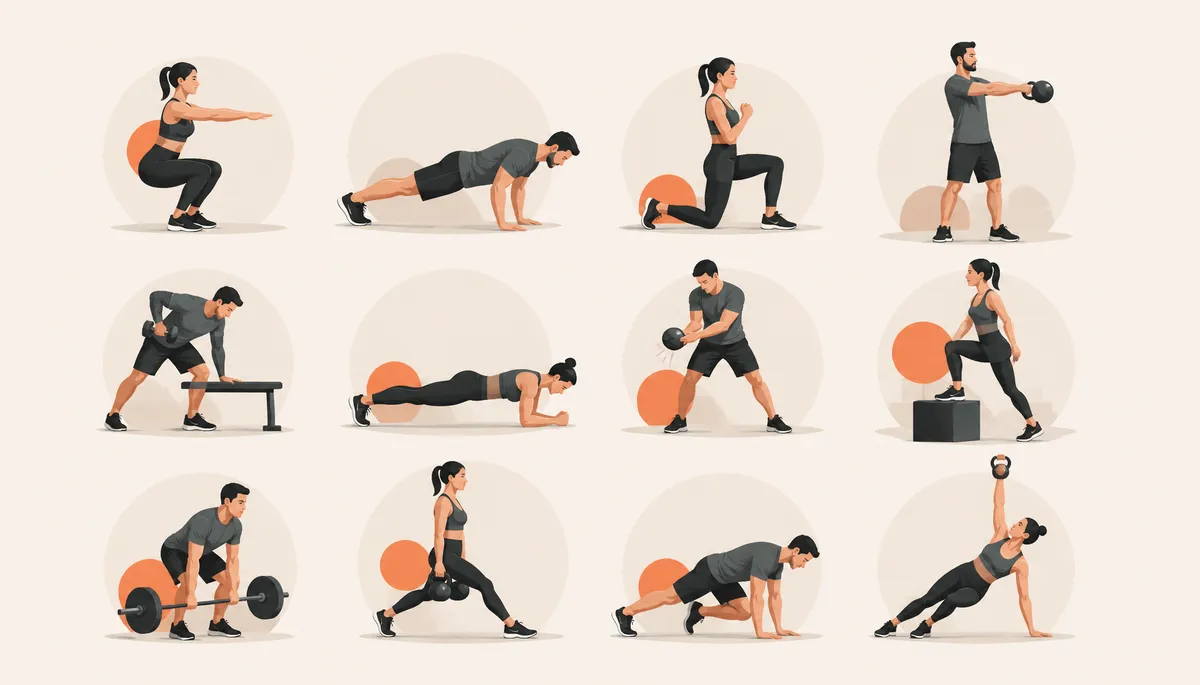
Here are 12 exercises covering the main functional movements. Start by mastering the first 5 if you're a beginner, then progressively add the others.
| Exercise | Target Movement | Level | Muscles Worked |
|---|---|---|---|
| Bodyweight squat | Sit down/stand up | Beginner | Quads, glutes, core |
| Front plank | Core stability | Beginner | Abs, lower back, shoulders |
| Forward lunge | Walking/lunging | Beginner | Quads, glutes, hamstrings |
| Stiff-leg deadlift | Bend/lift | Beginner | Hamstrings, glutes, lower back |
| Push-ups | Pushing | Beginner | Chest, triceps, shoulders, core |
| Kettlebell swing | Hip hinge | Intermediate | Glutes, hamstrings, core, shoulders |
| Goblet squat | Loaded squat | Intermediate | Quads, glutes, core, arms |
| Dumbbell row | Pulling | Intermediate | Lats, biceps, lower back |
| Bear crawl | Crawling | Intermediate | Shoulders, core, hips |
| Burpee | Jump + push | Advanced | Full body + cardio |
| Turkish get-up | Stand up with load | Advanced | Full body, stability |
| Thruster | Squat + press | Advanced | Legs, core, shoulders |
🆚 Functional Training vs Traditional Weightlifting
These two approaches aren't enemies, they're complementary. The question isn't which is better, but which matches your goals.
| Criterion | Functional Training | Traditional Weightlifting |
|---|---|---|
| Main goal | Overall performance, daily life transfer | Hypertrophy, maximal strength |
| Movement type | Multi-joint, full chains | Often single-joint, isolated muscles |
| Equipment | Body weight, kettlebells, med balls | Machines, barbells, heavy dumbbells |
| Posture benefit | Excellent (strengthens stabilizers) | Variable (imbalances if poorly programmed) |
| Injury risk | Low to moderate (natural movements) | Moderate to high (heavy loads) |
| Ideal for | Athletes, active people, beginners | Bodybuilders, powerlifters |
📋 4-Week Functional Training Program Example
Here's a sample program that alternates fundamental movements for complete development. Adjust reps and load to your level.
The program below is designed for 3 sessions per week. Each session lasts 35-45 minutes, including warm-up. Rest 60-90 seconds between sets.
| Day | Focus | Exercises (3 sets) | Finisher |
|---|---|---|---|
| Monday | Lower body strength | Goblet squat (10-12), Deadlift (10), Walking lunges (12/leg) | Plank 3×45 sec |
| Wednesday | Upper body + core | Push-ups (12-15), Dumbbell row (10-12), Dumbbell press (10) | Bear crawl 3×30 sec |
| Friday | Dynamic full body | Kettlebell swing (15), Thruster (10), Burpees (8-10) | Turkish get-up 3×3/side |
 The Atlo Approach: Functional Training Gets Smart
Atlo integrates functional training principles into a personalized program that evolves with your real data. Where a paper program stays static for 4 weeks, Atlo adjusts each session based on your recovery, nutrition, and past performance.
Atlo's AI coach generates custom functional training sessions, selecting exercises from a catalog of over 400 movements with videos. It considers your level, goals, available equipment, and crucially, cross-references this data with your sleep and nutrition to know if you're ready to push or if the session should be lighter.
Progressive overload tracking is built in: Atlo analyzes volume by muscle group, detects plateaus, and automatically adjusts loads, reps, or exercise complexity so you keep progressing without stagnating.
📚 Sources and References
These scientific sources and reference articles were consulted to build this guide.
🔗 Atlo Resources
Explore more content on training and performance:
Strength Training: The Complete Guide
Everything about strength training, different exercise types, and how to progress.
Cardio Program: Beginner to Intermediate Guide
Build an effective cardio program with our LISS and HIIT session examples.
Workout Program Generator
Create a custom program based on your goals, level, and equipment.
Strength Training: The Complete Guide
Learn how to structure strength training to build muscular power.
❓ FAQ
📖 Read next
Strength Training: The Complete Guide
Cardio Program: Beginner to Intermediate Guide
Personalized Workout Program: Comparison and Guide
Ready to transform your fitness?
Join the Atlo waitlist and receive a personalized functional training program, AI-generated and continuously adjusted based on your progress.
lockNo spam. We'll email you at launch.